By Daisy CL Mandap
 |
| Quarantine for local cases is being shortened because Penny's Bay is running out of space |
Health officials have announced that from today, Jan. 10,
the quarantine period for close contacts of locally acquired cases of Covid-19
will be shortened to 14 days, from the previous 21 days.
Dr Chuang Shuk-kwan from the Centre for Health Protection
said in today’s press briefing that the decision was reached after experts noticed
that the Omicron has a much shorter incubation period than previously
identified variants, particularly Delta.
Omicron infections show up within days, and rarely, if ever,
take 14 days before being detected, said Chuang.
Another factor was that because of a
recent surge in the number of people testing positive within the community,
there has been a corresponding increase in the number of close contacts that
need to be moved to quarantine centers.
Among this was the cluster of cases detected from the
birthday party on Jan 3 of Whitman Hung, a delegate to the National People’s
Congress. Chuang said it is now known that at least 214 people had been to the
gathering, and 104 of those identified as close contacts have been sent to
Penny’s Bay Quarantine Centre, including top government officials.
As of this morning about 900 units were shown to be
available at Penny’s Bay, but Chuang said that some 800 people were waiting to
enter the quarantine facility. This means there may not soon be enough space
for all those who need to be moved there.
But she said in response to queries that the
government has no similar plans to reduce the quarantine period for those
coming from overseas, most of whom are required to spend 21 days in isolation.
Currently local close contacts of cases with mutant strains
are required to spend 21 days in quarantine, counting from the last day of
exposure.
While this has been cut to 14 days from today, the close
contacts will continue to be tested frequently while in quarantine, and after
release, must still observe seven days of self-monitoring. They should also submit
themselves to compulsory testing on day 19 after their last day of exposure to
the local case.
Chuang also reported 24
newly confirmed cases of Covid-19, of which 19 were imported and five are
locally acquired, with one of them untraceable.
She mentioned seven
preliminary linked positive cases, including two relatives of a 3-year-old who
had previously tested positive for Covid-19 which he acquired from a dance
cluster in the Causeway
Bay area.
The two preliminary
cases, a 36-year-old female and a 38-year-old male, went strawberry picking on
Jan 2. Chuang said the woman apparently caught the virus during this activity,
but she developed a fever only on Jan.9
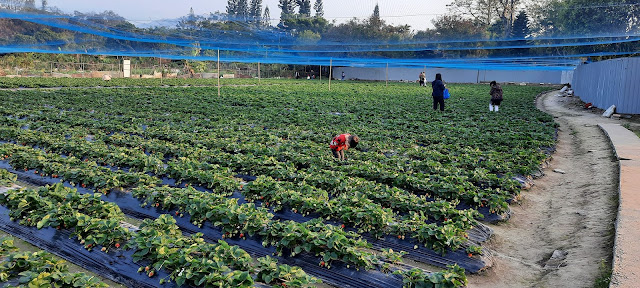 |
| Chuang said one of the preliminary cases caught the virus while picking strawberries on Jan 2 |
The man went to play
football with friends on Jan 4 in Aberdeen,
and tested negative on Jan 4 and 5.
Another case is that of
the father of a 36-year-old woman who worked parttime at SOGO department store
but spent much of her time at a family-owned pharmacy at Hands Shopping Centre
in Tuen Mun.
Chuang said she believes
the man caught the virus before his daughter as he started feeling unwell on
Jan 1 but did not seek medical attention.
After further investigation,
she said a “breakthrough” was reached as it turned out that a Cathay
pilot who previously tested positive, had visited the family’s pharmacy on Dec
27. Thus, the cases of both father and daughter are now classified as
import-related.
Another preliminary case
pertains to the 32-year-old female employer of one of the four Indonesian
domestic workers linked to the dance cluster in Causeway Bay.
The employer works as a sales person at the Dior store at the Landmark in
Central and had been at Penny’s Bay since Jan 6.
Other cases include a
33-year-old woman who works in a design firm in Kwun Tong and shared a flat
with two confirmed cases, a 52-year-old unvaccinated man who was moved to Penny’s
Bay on Jan 8 and started running a fever and coughing the next day; and a
16-year-old female student at Canossa College who attended a singing class in
Tin Hau and dined at a food hall on Wharf Road before being moved to PBQC on
Jan 8.
Confirmed positive cases on the
other hand include a 66-year-old female suspected of having caught the virus from
three infected neighbors who live five floors below her in Mei Sun building in
Tai Po.
A second overnight
lockdown of their residential building did not yield any new case. About 40
environmental samples were taken, and all came back negative except for four
which had inconclusive testing results.
Also confirmed was an
88-year-old woman whose relative gave a foot massage to the index patient in
the dance cluster. The masseuse tested positive earlier, so the elderly woman
who is unvaccinated and lives in Shau Kei Wan, was sent to PBQC as a close contact.
The last notable case is that of 43-year-old woman who accompanied her friend Celia Wong to Hung’s birthday
party in Wanchai on Jan 3.
The woman who works at iCable TV building in Tsuen
Wan joined three other friends in a restaurant for food and drinks before going
to the party at 9:30pm.
She and her friends who crashed the party were not
on the guest list. Chuang fears they were more like them who have yet to be
identified. She urged them to step forward so they could be tested.
Meanwhile, the Omicron count in Hong
Kong rose to 265 today, after 18 more cases were identified following
full genome sequencing analysis.
The CHP also imposed a two-week suspension on two passenger flights that arrived in Hong Kong on Jan 7:
Flight SQ007 operated by Singapore Airlines carried
eight passengers from San Francisco,
USA who tested
positive on arrival; and
Flight NH811 operated by All Nippon
Airways which came with six passengers who were found infected on arrival from Tokyo, Japan.
Both passenger flights will be banned from landing
in Hong Kong until Jan 24.